

Software DevelopmentConcept & Design
TBF + Partner AG

Autoscribed faced the challenge of efficiently preparing large volumes of product data for online retail. Especially for customers such as Obi, it was important to generate structured product descriptions and bullet points from Excel files in order to have them reviewed and approved by editors.
In the past, the tool relied on AI based text generation and the grouping of similar products. As the product evolved, this approach was adjusted. Today, the focus is clearly on proofreading and quality assurance, while text creation takes place upstream through external tools.
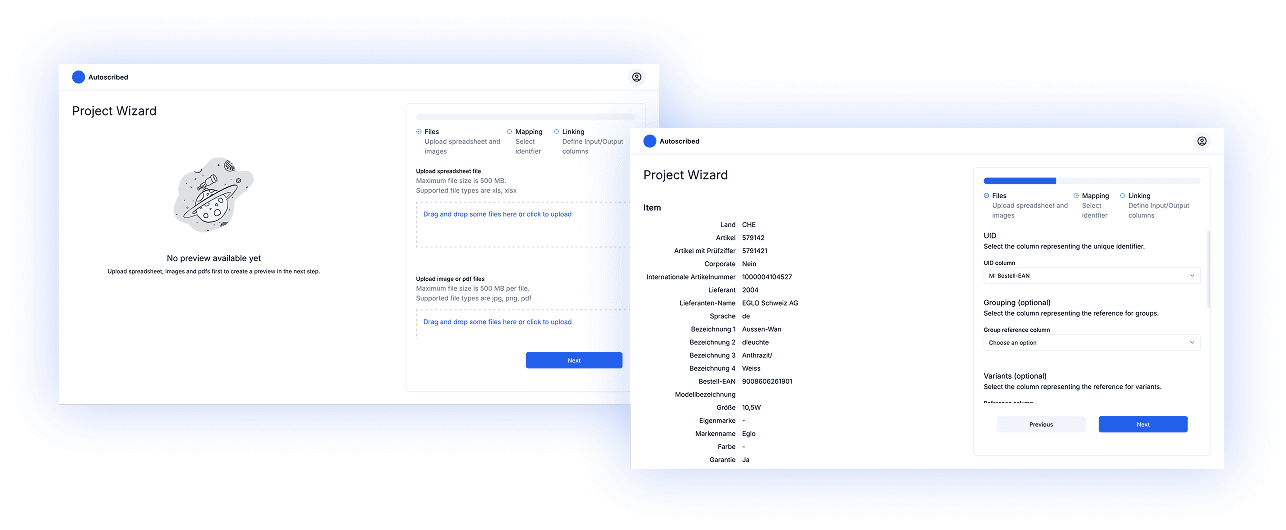
A central element of the tool is the Excel integration. Customers can upload their Excel files directly, define the relevant key and description fields, and receive an updated file once the proofreading process is complete.
While the product initially relied on AI to generate texts and automatically group similar products, the focus today is clearly on proofreading existing content. This ensures high text quality without the need for extensive rework.
To optimize the product data structure, we implemented a parent child hierarchy. This makes it possible to represent products in a clear structure: a core product acts as the parent, while related variants are modeled as child products, for example a base candle as the parent and its colored variants as the children. Editors can centrally maintain the content of the parent product and, if needed, selectively override it for individual variants. This makes data maintenance more efficient and consistent.
In addition, the tool ensures transparency in billing. Editors document their working hours directly in the system, can store their hourly rate in their profile, and thus create a clear overview of costs. Administrators, in turn, have the ability to view and analyze all project costs.
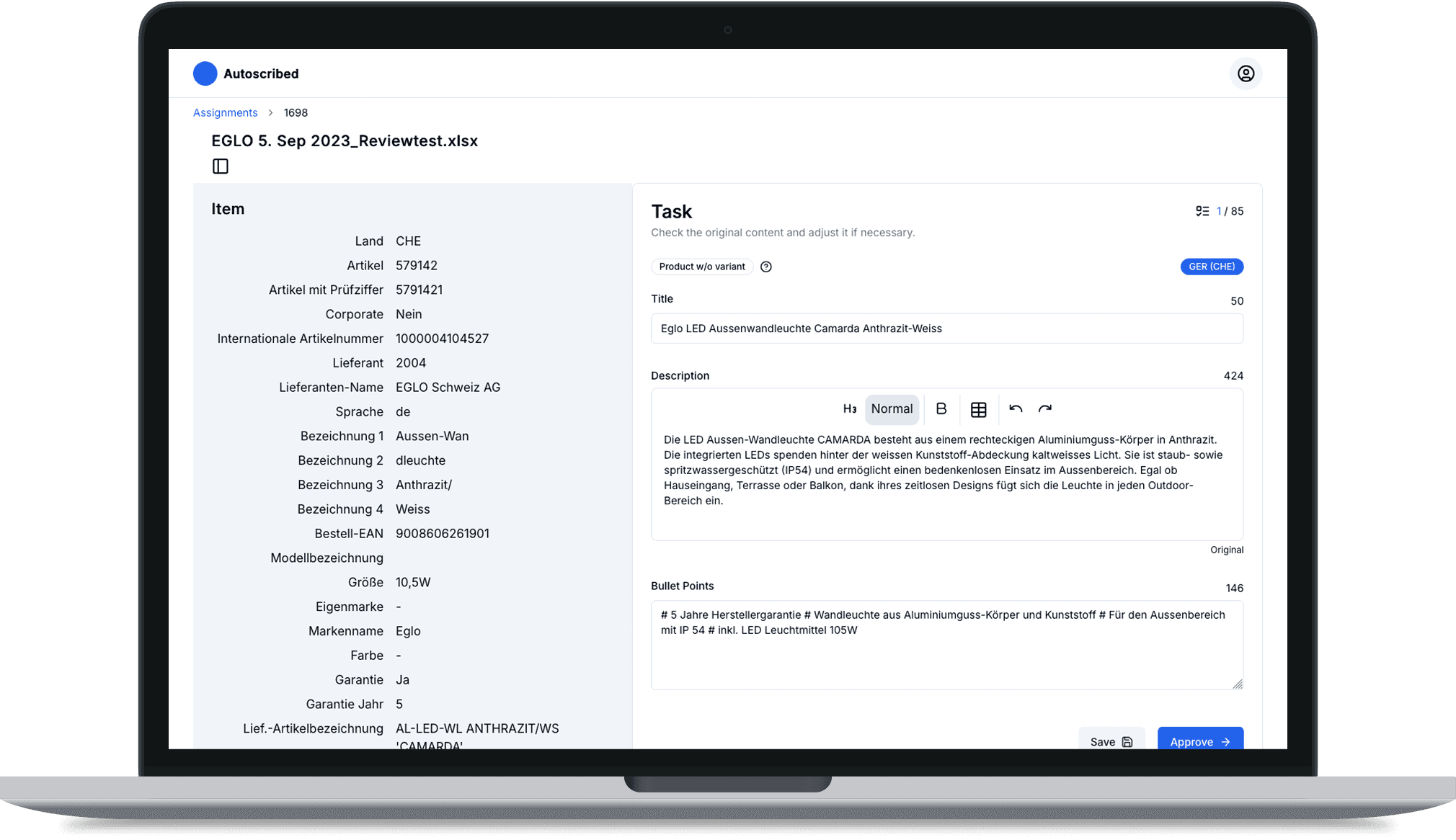
After the MVP, we continued to support the product from a conceptual perspective and refined it together with the team. A central part of our work was requirements management. We identified and translated the needs of the different user groups, both administrators and editors. Based on this, we were able to develop a well thought out user experience that serves both roles and clearly separates their respective workflows.
A special focus was placed on optimizing UX and UI within the proofreading process. This included the creation of an admin dashboard that allows new assignments to be created and managed and gives administrators a constant overview of project costs, including hours and wages. In parallel, an editor dashboard was developed to make it easier for editors to work on assignments and proofread descriptions and bullet points.
In addition, editors can manage personal data in the editor settings, define their hourly rate, and document working hours. All of this is complemented by carefully designed user flows that make usage clear and efficient for both roles.
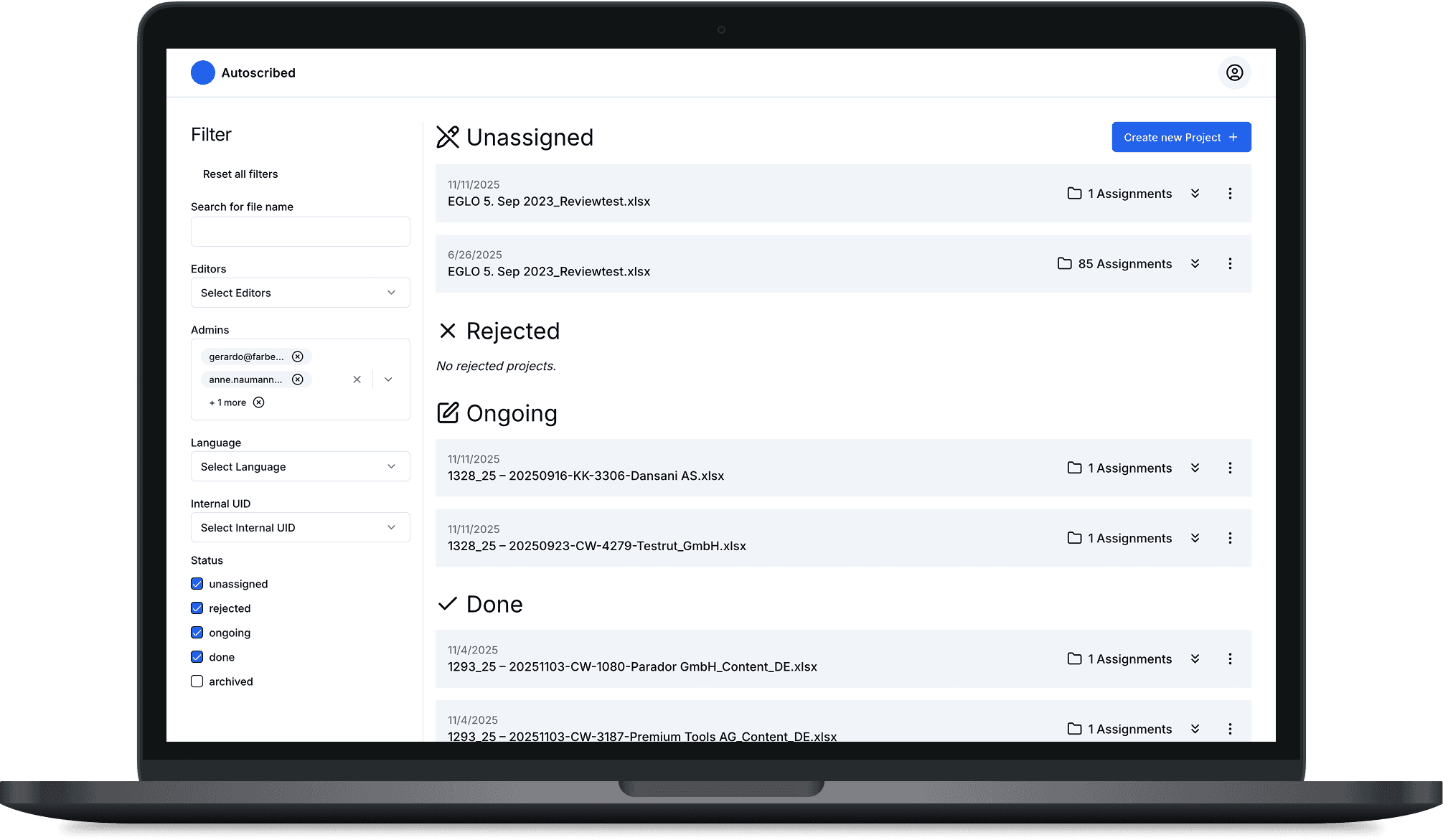
With the new focus, an AI experiment has evolved into a scalable proofreading tool that enables customers such as Obi to prepare data in a structured, transparent, and efficient way. Editors benefit from clear workflows and fair compensation, while administrators maintain full visibility into quality and costs at all times.

Marcel, Software developmentmarcel@farbenmeer.de